The manufacturing industry is entering a new phase of technological development, and CNC machining is at the center of this transformation. From artificial intelligence and robotic automation to advanced machine tools and smarter production systems, manufacturers are exploring new ways to improve accuracy, efficiency, and productivity.
Recent CNC machining trends in 2026 show how quickly the industry is evolving. Major manufacturers are developing humanoid robots capable of working alongside CNC machines, software companies are introducing AI-assisted programming tools, and demand for manufacturing equipment is showing strong growth in key markets.
These developments are not just important for large industrial manufacturers. They also influence smaller machine shops, product developers, engineers, and businesses that depend on precision-manufactured components.
With new technologies entering the market and investment in manufacturing equipment increasing, understanding these changes can help businesses make better production decisions.
AI and Robotics Are Transforming CNC Machining
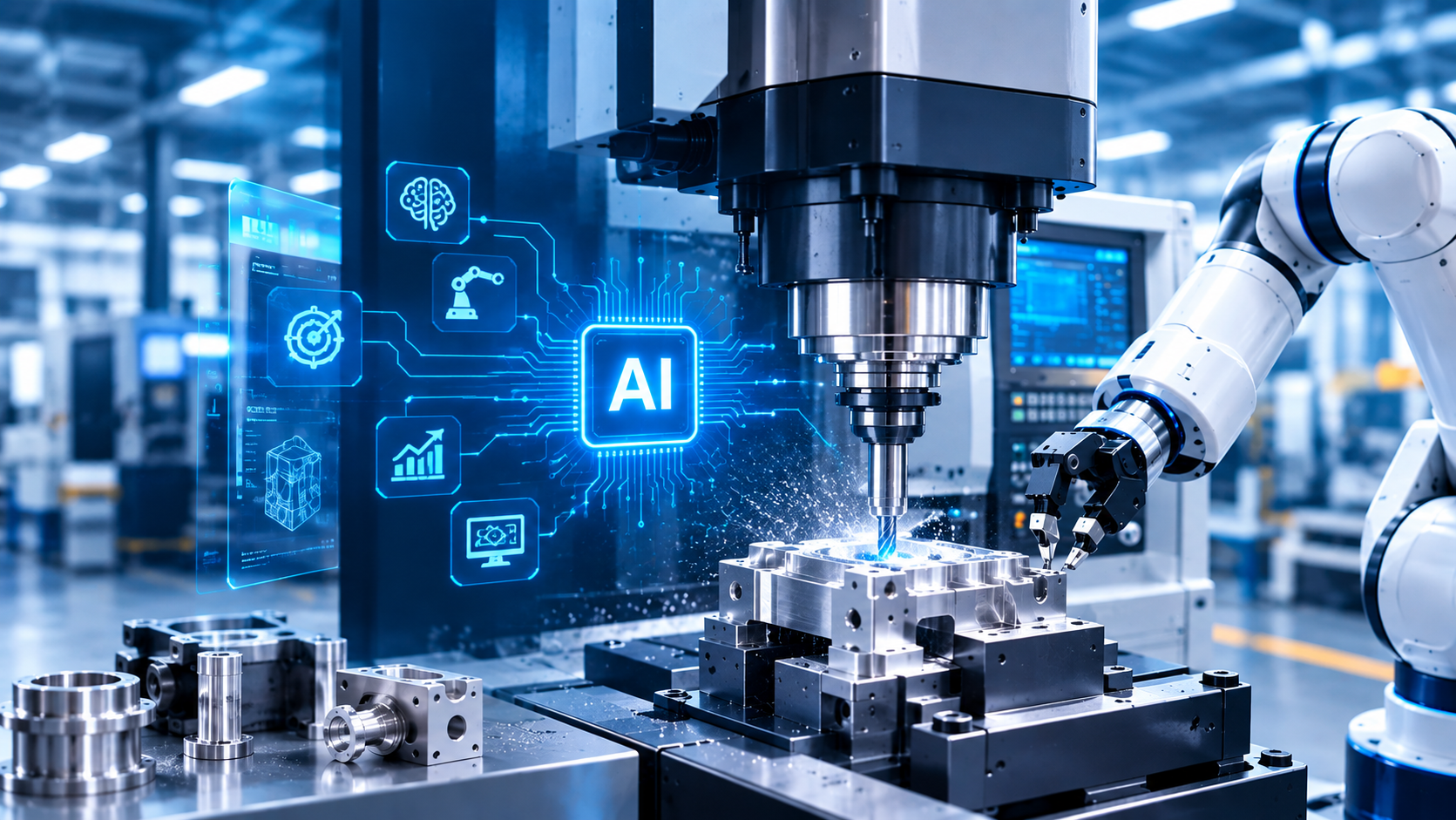
One of the most significant developments in precision manufacturing is the growing integration of artificial intelligence with CNC equipment.
Traditionally, CNC machines follow programmed instructions to cut, drill, mill, and shape materials. Although these machines are highly automated, many supporting tasks still require human operators.
These include loading workpieces, changing setups, removing finished parts, inspecting components, and handling unexpected interruptions.
Recent developments suggest that more of these activities could eventually be automated.
Mitsubishi Electric Introduces Humanoid Robot CNC Technology
On October 21, 2026, Mitsubishi Electric announced a machining system designed to allow humanoid robots and CNC machines to work together using physical AI.
According to the company, the technology enables robots to assist with several manufacturing activities, including machine setup, cleaning, finished-part handling, inspection, and troubleshooting. The system combines AI-based task planning, CNC machine communication, and humanoid robotics to coordinate manufacturing operations.
Mitsubishi Electric also announced plans to demonstrate the system at JIMTOF 2026, the major machine tool exhibition in Tokyo.
This development addresses one of the challenges facing modern manufacturing: the difficulty of automating tasks that traditionally depend on human flexibility and physical interaction.
Conventional industrial robots can perform repetitive activities efficiently, but their installation may require additional equipment, specialized programming, or modifications to existing production lines.
Humanoid robots could eventually offer greater flexibility when working in environments originally designed for human operators.
However, the technology is still developing. Its wider industrial adoption will depend on reliability, safety, integration costs, and performance in real machining environments.
What Robotic Automation Means for Manufacturers
Greater automation could help manufacturers improve operations in several ways:
- Reduce repetitive manual tasks during production.
- Support longer machine operating periods.
- Improve consistency in material handling.
- Allow skilled employees to focus on programming, quality control, and process improvement.
- Reduce certain interruptions between machining operations.
For companies producing precision components, these developments could create opportunities to improve production planning and maintain more predictable manufacturing workflows.
Still, automation does not eliminate the importance of experienced machinists. Technical knowledge remains essential for selecting cutting tools, interpreting engineering drawings, managing tolerances, and ensuring finished parts meet specifications.
AI-Powered Software Is Changing CNC Programming
Artificial intelligence is also influencing the software used to prepare machining operations.
CNC programming can be time-consuming, particularly when manufacturers work with complicated geometries, multiple setups, or advanced multiaxis machines.
Computer-aided manufacturing software helps programmers create toolpaths, select machining strategies, and simulate operations before production begins.
In 2026, software developers are introducing tools designed to make these processes easier to understand and manage.
GibbsCAM 2027 Introduces Smarter Programming Features
The newly introduced GibbsCAM 2027 includes several improvements intended to streamline CNC programming.
These developments include enhanced workspace visualization, improved simulation review, expanded multiaxis machining strategies, and updates to the GibbsCAM Copilot assistant.
The improved Copilot provides clearer responses, supporting images, and links to reference materials that programmers can use to verify information.
Other improvements allow users to examine tools along their programmed paths and review machining conditions more easily.
These capabilities can help programmers identify potential problems before a component reaches the shop floor.
However, the Copilot should not be confused with a fully autonomous programming system.
Machining decisions and program validation still require qualified human oversight.
Why Better CNC Programming Matters
Efficient programming is an important part of precision CNC machining.
Even when a machine is capable of extremely accurate movement, poorly planned machining operations can result in unnecessary production time, tool wear, or dimensional problems.
Improved programming tools can help manufacturers evaluate machining strategies earlier and reduce avoidable adjustments during production.
For businesses ordering custom parts, more efficient preparation may contribute to smoother project execution, particularly when components require complex features or multiple machining operations.
Five-Axis CNC Machining Continues to Advance
Another important development in 2026 is the continued improvement of five-axis machining technology.
Unlike conventional three-axis CNC machining, five-axis systems allow cutting tools or workpieces to move along additional rotational axes.
This flexibility can make it easier to manufacture complex shapes while reducing the number of times a component needs to be repositioned.
Five-axis machining is particularly valuable for components with angled features, curved surfaces, and geometries that are difficult to produce using traditional setups.
JIMTOF 2026 Highlights New Precision Manufacturing Equipment
The Japan International Machine Tool Fair, held from October 26 to 31, 2026, is showcasing developments in CNC machinery, automation, and advanced manufacturing.
Among the equipment featured in Nidec's JIMTOF 2026 exhibition is the VB-X650 five-axis machining center.
The machine is designed to support high-speed machining while maintaining a compact factory footprint.
Nidec is also highlighting the MVR-5X double-column milling machine, which uses an advanced attachment to provide additional flexibility when machining large components.
Its exhibition materials describe a digital twin platform intended to help manufacturers simulate machine movements and prepare programs before production.
Other exhibited technologies include precision grinding equipment, multitasking machines, and automated manufacturing systems.
Benefits of Advanced Five-Axis Machining
For suitable components, advanced five-axis machining offers several practical advantages.
Fewer setups: Complex features can sometimes be machined without repeatedly removing and repositioning the workpiece.
Better access: Cutting tools can approach difficult surfaces from multiple angles.
Greater flexibility: Manufacturers can produce intricate components that would otherwise require more complicated processes.
Improved consistency: Reducing setups can help minimize certain positioning errors.
These benefits are particularly relevant to aerospace, automotive, robotics, medical equipment, and industrial machinery manufacturing.
Nevertheless, five-axis machining is not automatically the best option for every project.
Simpler components may be more economical to produce through conventional CNC milling or turning.
The most suitable machining method depends on the design, material, tolerance requirements, production quantity, and total manufacturing cost.
US Manufacturing Equipment Orders Show Strong Growth
Technological innovation is only one part of the story. Recent industry data also points to significant manufacturing investment.
On October 12, 2026, the Association For Manufacturing Technology (AMT) reported that US orders for metalworking machinery reached $732.9 million in August 2026.
According to the AMT manufacturing technology orders report, this represented a 36.3% increase compared with August 2025 and a 21% increase from July 2026.
Total machinery orders during the first eight months of 2026 reached approximately $4.76 billion, representing year-over-year growth of 36.9%.
The report also identified six consecutive months in which machinery orders exceeded $500 million.
These figures suggest that businesses continue to invest substantially in metalworking manufacturing equipment.
What Rising Machine Tool Orders Indicate
Higher machinery orders can reflect manufacturers' efforts to increase capacity, replace aging equipment, or introduce more productive technologies.
New machinery investment may also support applications that require improved precision, more complex geometries, or greater production flexibility.
However, order values should not be interpreted as a direct measure of the number of parts being manufactured.
Equipment prices, product mix, and the timing of major purchases can influence reported totals.
Even with these limitations, the latest data highlights the importance of manufacturing technology investment in the current industrial environment.
For companies sourcing precision components, this creates a useful reason to evaluate manufacturing partners based on their technical capabilities, quality systems, and ability to handle changing production requirements.
Cutting Tool Demand Reflects Changing Manufacturing Conditions
Cutting tools are essential to almost every CNC machining operation.
End mills, drills, inserts, and specialized cutting tools remove material from metal or plastic workpieces to create the required dimensions and features.
Changes in cutting tool demand can therefore provide insights into manufacturing activity.
On October 21, 2026, AMT and the U.S. Cutting Tool Institute reported that US cutting tool shipments totaled $278.6 million in August.
This represented a 32.2% increase compared with August 2025.
Year-to-date shipment value reached $2.03 billion, an increase of 22.4% over the corresponding period in 2025.
However, the report emphasized that rising raw material costs contributed substantially to the higher shipment values.
After accounting for price increases, year-to-date growth was reported at 12.5%.
This distinction matters because higher spending does not always mean that manufacturers are consuming proportionately more tools.
Why Cutting Tool Efficiency Matters
Manufacturers must balance cutting performance, tool life, material properties, and production costs.
Poor tool selection can increase machining time or create unnecessary wear.
Similarly, aggressive cutting strategies may improve material removal rates but can compromise tool life or machining stability if not properly controlled.
As cutting tool prices change, manufacturers have additional reasons to improve toolpath planning, monitor tool performance, and reduce avoidable waste.
These practices can support more predictable production costs while maintaining part quality.
AI Is Making CNC Machining Quotations More Efficient
Precision manufacturing begins long before a cutting tool touches a workpiece.
When customers submit drawings or 3D models, manufacturers must assess material requirements, part complexity, machining operations, tolerances, and production quantities.
Preparing an accurate quotation can require considerable engineering knowledge and time.
AI-powered estimating software is beginning to change this process.
CloudNC Launches AI-Powered Quote Agent
On October 13, 2026, CloudNC introduced Quote Agent, an AI-assisted solution designed to help machine shops evaluate manufacturing jobs and prepare quotations.
According to CloudNC, the system can help reduce quoting work from hours to minutes by assessing manufacturing risks and preparing estimates for review.
The software combines manufacturing models with AI technology to analyze potential machining requirements.
It can also generate supporting documents, including design-for-manufacturing reports and inspection-related documentation.
Importantly, the final quotation still requires review and approval by a human estimator.
How Faster Quotations Benefit Customers
For engineers and product development teams, quotation speed can affect project planning.
A delayed manufacturing estimate may slow decisions about material selection, design changes, supplier comparison, or production scheduling.
More efficient quoting systems could help customers receive earlier feedback and make informed decisions before placing orders.
Yet speed should never replace technical accuracy.
Manufacturing quotes still need to reflect actual machining capabilities, production requirements, finishing processes, inspection needs, and delivery conditions.
For CNC machining providers such as Superapid, which manufactures custom metal and plastic components for prototyping and production, the broader shift toward faster communication and manufacturing evaluation reflects the expectations of today's engineering customers.
Businesses increasingly need manufacturing partners that understand design requirements and can support projects from early prototypes through production.
Global Trade Policies Remain an Important Consideration
Alongside technology and market demand, international trade developments are affecting the outlook for manufacturing equipment.
On October 28, 2026, the US administration announced that it would pursue negotiations concerning imports of robotics, industrial machinery, and related components.
According to the White House announcement, the action followed a national security review of imported industrial equipment.
No immediate new tariffs were imposed through that announcement, but additional trade measures remain possible depending on future negotiations.
For manufacturers, uncertainty surrounding equipment imports can influence long-term investment decisions.
Companies purchasing CNC machinery may need to consider equipment availability, import requirements, and changes in acquisition costs.
It is important to distinguish these potential machinery-related measures from the tariff treatment of finished CNC-machined parts, which depends on separate product classifications and applicable trade rules.
Manufacturers and buyers should therefore monitor official policy updates rather than assume that a single announcement applies equally to all industrial products.
What CNC Machining Trends in 2026 Mean for Businesses
Taken together, these developments reveal a manufacturing industry focused on improving efficiency without sacrificing precision.
Artificial intelligence is becoming more useful in programming and estimating. Robotics developers are exploring more flexible factory automation. Machine builders are improving five-axis capabilities, while manufacturers continue investing in production equipment.
For companies purchasing CNC-machined components, these changes highlight several important considerations.
Precision and Quality Remain Essential
New technology can improve manufacturing processes, but finished components must still meet their engineering specifications.
Dimensional accuracy, surface finish, material suitability, and repeatability remain critical.
Customers should communicate tolerance requirements clearly and agree on appropriate inspection methods before production begins.
Prototyping Supports Better Product Development
Rapid prototyping allows engineers to evaluate physical components before committing to larger production quantities.
CNC machining is especially useful when prototypes need to be manufactured from the same metal or engineering plastic intended for the final product.
Functional testing can reveal problems involving fit, assembly, mechanical performance, or manufacturability.
Identifying these issues early may reduce expensive revisions during later manufacturing stages.
Material Selection Influences Performance and Cost
Different materials require different machining approaches.
Aluminum is commonly selected for its relatively low weight and machinability, while stainless steel may be preferred when corrosion resistance and strength are important.
Engineering plastics such as ABS, nylon, POM, and PEEK provide additional possibilities where weight, insulation, wear behavior, or chemical resistance must be considered.
Choosing the appropriate material helps manufacturers balance functional performance with machining requirements and production costs.
Reliable Suppliers Matter as Much as Modern Machines
Advanced equipment alone does not guarantee successful manufacturing.
A capable supplier must also understand drawings, identify potential manufacturing problems, communicate clearly, and maintain quality throughout production.
For businesses sourcing precision CNC machining services, it is useful to evaluate a supplier's experience with relevant materials, machining processes, inspection requirements, and order quantities.
Strong collaboration between engineers and manufacturers can make the difference between a successful production project and repeated delays or revisions.
The Future of Precision CNC Machining
The latest CNC machining news suggests that the industry is moving toward greater digital integration and more flexible automation.
AI-assisted software may continue reducing repetitive programming and estimating work.
Robotic systems could take on a wider range of machine-tending activities, while improvements in machine tools may make complex manufacturing processes more accessible.
At the same time, the practical requirements of precision manufacturing will remain unchanged.
Every successful component still depends on an appropriate design, suitable materials, carefully planned machining operations, and reliable inspection.
For manufacturers, the challenge is not simply adopting the newest technology. It is identifying which improvements deliver measurable benefits in accuracy, cost, efficiency, and production reliability.
As these technologies mature, businesses that combine modern manufacturing methods with sound engineering practices will be better positioned to meet evolving customer expectations.
Conclusion
The CNC machining trends of 2026 demonstrate how artificial intelligence, automation, advanced five-axis equipment, and changing market conditions are shaping precision manufacturing.
Recent developments from Mitsubishi Electric, GibbsCAM, Nidec, CloudNC, and industry organizations such as AMT show that innovation is occurring across multiple stages of the manufacturing process.
Although many technologies are still evolving, their direction is clear: manufacturers are seeking smarter workflows, more efficient production, and greater flexibility.
For businesses developing products or sourcing precision components, staying informed about these developments can support better supplier decisions and more effective manufacturing strategies.
Precision CNC Machining Solutions from Superapid
Superapid is a China-based precision manufacturing company specializing in custom CNC-machined metal and plastic parts for rapid prototyping and production. With CNC milling, CNC turning, and complementary manufacturing services, Superapid helps engineers, product developers, and businesses turn technical designs into finished components. Whether you need a functional prototype or custom production parts, explore Superapid's CNC machining services to discuss your project requirements.