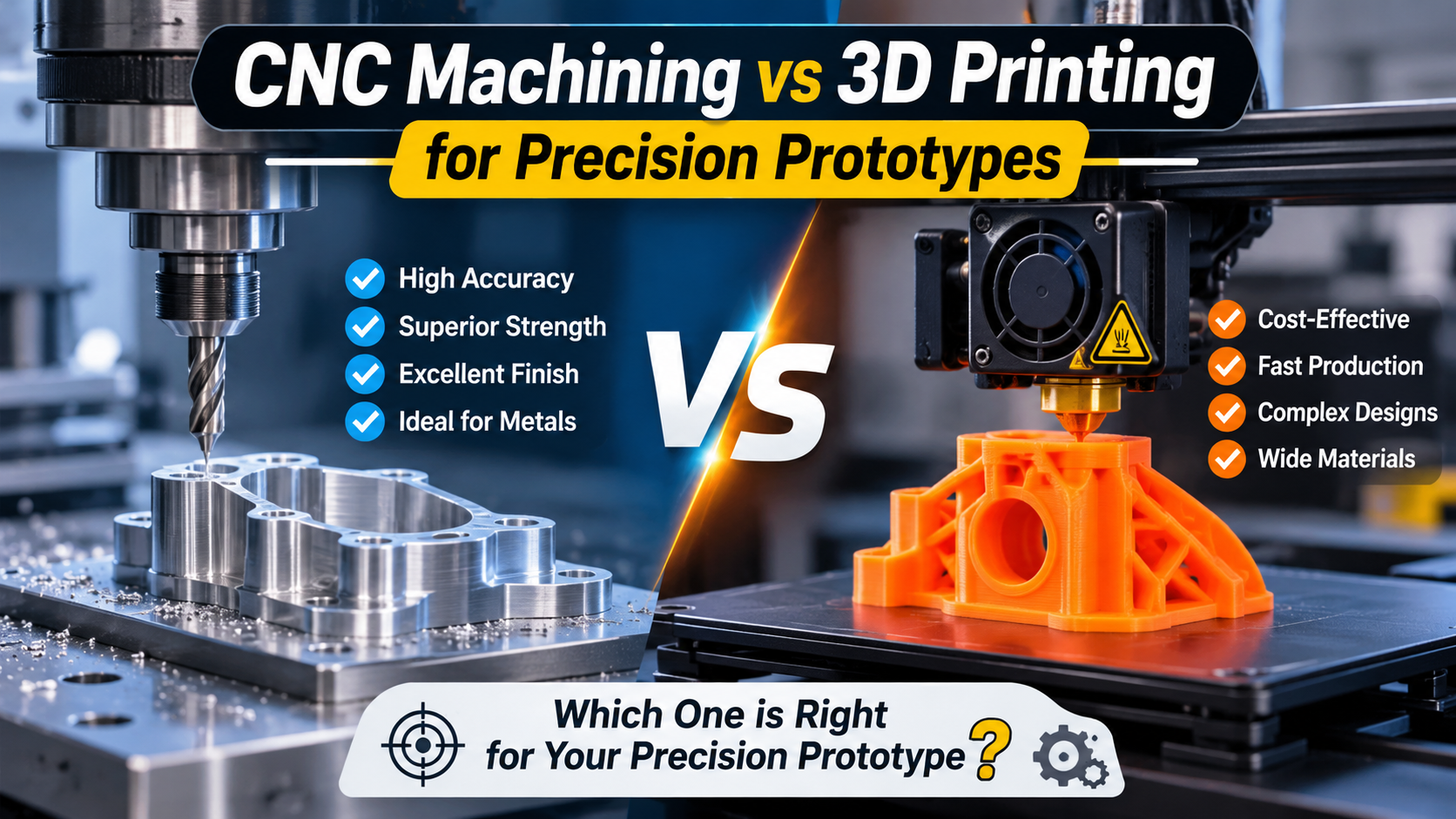
Choosing between CNC machining and 3D printing prototypes starts with one question: what must the prototype prove? A model for checking appearance has different requirements from a component that must hold a bearing, withstand heat, or survive repeated loading.
Both processes turn digital designs into physical parts, but their strengths differ. CNC machining is often a strong choice for tightly controlled features and specified stock materials. Additive manufacturing offers flexibility for complex shapes and repeated design changes.
The best decision considers the complete route to a usable, inspected prototype—not simply the quoted manufacturing price.
CNC Machining vs 3D Printing at a Glance
CNC machining removes material from stock using controlled cutting tools. 3D printing builds parts layer by layer. Neither process is universally faster, cheaper, or more suitable for functional testing.
| Factor | CNC machining | 3D printing |
|---|---|---|
| Main advantage | Controlled features in a wide range of stock materials | Complex geometry and flexible design iteration |
| Dimensional control | Often preferred for demanding mating features | Depends strongly on process, material, geometry, and finishing |
| Material selection | Machinable metal and plastic grades | Filaments, photopolymer resins, and polymer or metal powders |
| Geometry constraints | Cutting-tool access and workholding | Supports, orientation, build size, and material removal from cavities |
| Surface condition | Tool marks; finishing may be needed | Layer or powder texture; finishing varies by process |
| Cost drivers | Setup, machining time, material, inspection | Build time, material, packing, supports, post-processing |
| Common prototype uses | Precision interfaces and material-specific tests | Concept models, complex parts, and suitable functional tests |
Protolabs Network similarly identifies dimensional accuracy and geometric complexity as key factors in choosing between the processes.
What Does Precision Mean for a Prototype?
Accuracy, precision, and tolerance are related but different. Accuracy describes closeness to the intended dimension. Precision describes repeatability. Tolerance defines the acceptable variation around a specified requirement.
A machine can produce repeatable parts that are consistently the wrong size. Equally, an attractive prototype can fail an assembly check because its mounting holes are misplaced.
Layer height and pixel size should not be treated as guaranteed dimensional tolerances. Formlabs explains that overall accuracy depends on the printing system and process, rather than a single resolution specification.
Start by defining what matters. For an illustrative instrument housing, the outside shape may only need to feel comfortable, while the connector opening must align with a purchased component. Those features should not automatically receive identical tolerances.
Accuracy and Fit of 3D Printing Prototypes
When CNC Machining Has the Advantage
CNC machining is frequently suitable for bearing seats, locating features, threaded interfaces, and flat mating surfaces that need controlled dimensions.
However, no single tolerance describes every CNC service. For example, Protolabs lists a general machining tolerance of ±0.1 mm or better for its UK service and tighter capabilities down to ±0.010 mm through its network. These are supplier-specific capabilities, not guarantees for every geometry or material.
Provide a drawing that identifies critical dimensions, datums, and any geometric requirements. Request confirmation that the supplier can inspect those features after finishing.
When Printing Can Meet the Requirement
3D printing prototypes can provide useful accuracy for fit checks and functional assemblies when the process is matched to the application.
Printed dimensions can change with orientation, thermal effects, curing, and geometry. Formlabs notes that SLA build orientation can affect dimensional accuracy and surface finish.
For an illustrative snap-together enclosure, print a small test section containing the latch and mating wall before ordering the full assembly. This helps establish workable clearance with the selected material and machine.
Avoid compensating blindly by enlarging every hole or shrinking every external dimension. Different features may behave differently.
Which 3D Printing Process Should You Compare?
“3D printing” covers several manufacturing methods. Comparing CNC machining only with a basic filament printer can overlook other useful options.
FDM or FFF
Fused deposition modelling, also called fused filament fabrication, deposits thermoplastic through a nozzle. It is useful for shape studies, packaging checks, and suitably designed functional prototypes. Layer bonding and orientation require attention when parts carry loads.
SLA
Stereolithography cures photopolymer resin. It is useful for fine details and smooth-looking models, with engineering resins available for particular performance requirements. Resin selection and post-curing conditions matter.
SLS
Selective laser sintering builds polymer parts in a powder bed. Surrounding powder supports the build, avoiding the dedicated support structures used by many other processes. Powder removal and surface texture still need consideration.
Metal Additive Manufacturing
Metal printing can create features such as complex internal passages. Precision interfaces may subsequently require machining. Evaluate the finished manufacturing route, including thermal treatment and inspection, when comparing it with CNC production.
Materials and Functional Testing
Material selection should follow the test objective. A prototype intended to demonstrate grip shape does not need the same material fidelity as one being assessed for stiffness or thermal behaviour.
CNC machining offers access to many engineering plastics and metals in stock form. Printed materials must be evaluated by their specific grade and processing conditions. An “ABS-like” photopolymer should not automatically be treated as equivalent to ABS thermoplastic.
Protolabs distinguishes resins that mimic selected properties from actual engineering thermoplastics.
Do not assume that every printed part is weak between layers. Formlabs has published testing showing largely consistent mechanical properties across build orientations for the SLA materials and conditions investigated. That evidence should not be generalized to every additive process or resin.
For 3D printing prototypes used in engineering tests, document:
- Material grade and supplier.
- Build orientation and relevant processing settings.
- Washing, curing, thermal treatment, or other finishing.
- Test temperature, loading direction, and acceptance criteria.
A useful distinction is material similarity versus process similarity. Even a machined plastic prototype made from the intended polymer does not reproduce every characteristic of an injection-moulded part, such as weld lines or moulding-induced orientation. Final validation should represent the intended production route where those differences affect performance.
Design Complexity and Manufacturing Constraints
Additive manufacturing can make lattices, branching channels, and shapes that cutting tools cannot easily reach. CNC machining requires access for tools and a practical way to hold the workpiece.
However, printable does not mean unconstrained. A hollow part needs a workable method for removing trapped powder, resin, or supports. A thin wall must survive both manufacturing and handling.
For machining, review deep pockets, slender features, internal corner radii, and the number of required setups. Protolabs highlights tool access and internal geometry as important differences between additive and subtractive manufacturing.
Consider an illustrative fluid manifold. If it contains curved internal passages, printing may simplify its construction. If it is mainly a rectangular block with accessible drilled passages and precision ports, machining may be straightforward. The CAD model and functional requirements should drive the comparison.
Cost of CNC Machining vs 3D Printing Prototypes
There is no reliable universal price ratio between the two processes.
A complex one-off shape may be economical to print, while a simple turned component may be inexpensive to machine. Quantity can change the result because setup costs, machine utilization, and batch packing affect the total differently. Protolabs identifies part-specific factors as central to pricing.
Compare quotes for the same deliverable. Both should include the required material, quantity, finishing, inspection, and delivery terms.
Use this practical calculation:
Cost per accepted prototype = total project cost ÷ number of prototypes that pass the agreed checks.
For example, a cheaper printed housing may become the more expensive option if it needs extensive manual finishing before the assembly test. Conversely, machining an early concept may waste money if the design is likely to change immediately.
Request separate prices for the first prototype and a small repeat batch. This makes the cost of iteration easier to understand.
Lead Time and Surface Finish
Compare the time to receive a test-ready component, rather than machine time alone.
A print may need cooling, cleaning, support removal, curing, and inspection. Machined parts may need material procurement, programming, fixturing, deburring, and finishing. Supplier workload can influence either schedule.
Surface finish also affects function. A surface that looks acceptable may still be unsuitable for sealing, sliding contact, or a cosmetic evaluation.
Formlabs identifies orientation as a factor in SLA surface quality, while Protolabs describes machining and other finishing operations for metal-printed parts.
Ask suppliers to quote the final surface requirement. For an illustrative sliding mechanism, identify the contact surfaces explicitly rather than requesting a vaguely “smooth” finish across the whole part.
Combining CNC Machining and 3D Printing
The two processes can be used sequentially during development or together on one component.
A practical development sequence is:
- Print early models to explore size, shape, and assembly layout.
- Revise the design using feedback from those checks.
- Produce functional prototypes using materials and processes appropriate to the intended tests.
- Inspect critical dimensions and record the results.
- Validate the production design using representative manufacturing conditions.
Another option is to print a complex metal body and machine its precision interfaces. Protolabs specifically describes post-process CNC machining as a way to improve tolerances and surface finish on metal-printed parts.
Plan this hybrid approach before printing. The machinist needs accessible surfaces, usable reference features, and sufficient material allowance.
How to Choose the Right Prototyping Process
Use the following questions to build a clear manufacturing brief:
- What decision will this prototype support?
- Which dimensions affect assembly or performance?
- Must the material match a specified production grade?
- Will the part experience load, heat, chemicals, or repeated use?
- Can the geometry be manufactured and inspected?
- How many design revisions are expected?
- What is the intended production process?
Then compare supplier responses against those requirements. For demanding parts, a short technical review often reveals more than an automated price alone.
Frequently Asked Questions
Are 3D printing prototypes accurate enough for precision assemblies?
They can be, depending on the process, material, feature geometry, and required fit. Validate critical dimensions on finished parts instead of relying on advertised printer resolution.
Is CNC machining always more expensive than 3D printing?
No. A simple machined part can be competitive, especially when printing requires substantial finishing. Compare complete quotes for identical requirements.
Can printed prototypes be used for functional testing?
Yes, when their material properties and manufacturing conditions suit the test. A successful visual or fit check does not establish suitability for structural, thermal, or durability testing.
Can a 3D printed prototype be CNC machined afterward?
Some printed parts can be machined to refine holes, mating surfaces, or other features. Material behaviour, workholding, accessibility, and machining allowance must be considered.
Conclusion
CNC machining and 3D printing prototypes serve different engineering needs. Machining is often suitable for controlled interfaces and specified stock materials, while printing can simplify complex shapes and support design iteration.
Choose the process that answers the prototype’s intended question. Define critical requirements, compare finished-part costs, and inspect what matters. For many projects, using both technologies at appropriate stages provides the most useful development evidence.